
Article: Luke H. Reynolds- The Night-Owl Troubadour Who Built a Stage from a Livestream
“People feel invisible,” Luke says simply.
“Live lets us look someone in the eye and say, I see you.”
In that sentence lies the heartbeat of his music — connection over perfection, compassion over clout.
What began as a work talent show has become a lifeline for thousands who tune in not just to listen, but to feel seen.
- Musician: Luke H. Reynolds -

If you ask Luke H. Reynolds how this all started, he doesn’t talk about labels or showcases. He talks about a work talent show on a video call. A tech-company meeting. A guitar just off camera. And a nudge from a world that had suddenly moved online. He played. He won. And when the stream ended, something had begun.
From there, his rise didn’t follow the usual map. Luke found TikTok Live, not as a viral clip machine, but as a room he could build night after night. “I’ll keep showing up if you keep showing up,” he told early viewers. They did. He did. In May 2022, he finished a week as one of America’s Top 5 earners on TikTok Live—not because of spectacle, but because of consistency, community, and kindness.
It’s an odd sentence to write about a self-described dad who works in tech by day and sings after the family’s asleep—but that’s the point. He’s living proof that a music career can grow out of ordinary life, if you bring extraordinary heart.
The first “bump”: Culver City
When TikTok invited Luke to perform at HQ in Culver City, he walked into the famous Red Room as (very likely) the first live streamer to play there post-lockdown. “It felt crazy,” he says, still a little stunned. “How do I top this?” The answer he heard from TikTok, and his agency was: original music.
So, he wrote. He found a producer. He flew back to LA to film a video on Malibu beach with actor-director Paul Butcher’s team. The imposter syndrome didn’t vanish, but the work did what work does—it stacked, piece by piece, into momentum.

The room he built, and the rules he lives by
Luke’s live shows are deceptively simple: a corner of the “plounge” (playroom + lounge), a triangle of lights and gear, guitars within reach, 1300+ songs in his fingers, and a chat that feels like regulars at the same cozy bar. He reads while he plays. He calls people by name. He takes requests whether or not someone gifts. “Live isn’t a pay-to-play,” he says. “People come to be seen.”
That philosophy—music as companionship—explains why his community funds everything: the guitars, the studio time, the first releases. He jokes that he’s the boat, but they’re the wind. And he means it. Many of his originals begin as letters to them, written after a tough show or a late message from a listener in a hard place. He co-writes with Mark McKee, then takes the song back to the room that sparked it: “We try it live. If they feel it, we know.”
Not every chapter has been smooth. Luke pushed so hard he injured his voice once; now he guards Mondays and Tuesdays for rest. He wrestles the algorithm like the rest of us. He rides the unpredictable tides of gifting, policy rumors, and platform changes.
Through it all, he keeps a day job he loves at CISCO, a communications company, and he laughs when trolls say, “don’t quit your day job.” “I’m not trying to,” he grins. “I like my life.”
A catalog made of lives
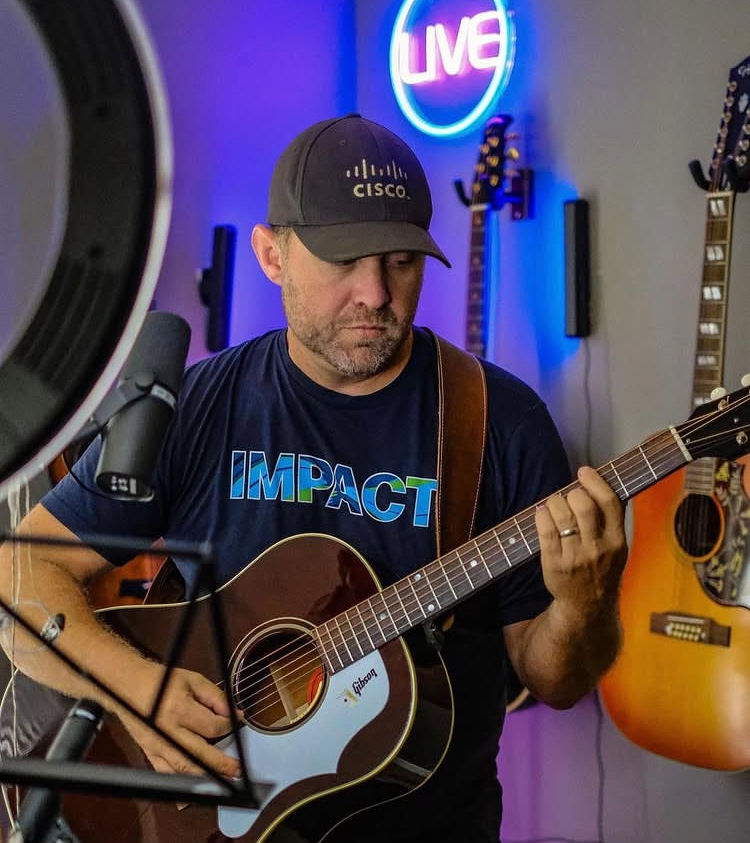
Part of Luke’s magnetism is the breadth of his musical memory. He plays by ear—piano, acoustic, some electric, and for a few years even violin (recitals alongside five-year-olds, which he swears were a blast).
On any night, a request might surface an old Glen Campbell favorite from his dad, or a ’90s staple from his own youth, or something touched by the hair-metal rides with his brother Brent.
The lineage is clear: Simon & Garfunkel fingerpicking from his father, Guns N’ Roses from his brother, and a little bit of everything from a life spent listening.
That history occasionally waves back: Michael Bublé in the comments, Sixpence None the Richer sharing a clip, Billy Corgan nodding at a “Disarm” cover, Peter Frampton popping in. Luke calls those moments “bumps”—tiny spotlights that help new people find the room.
Family, boundaries, and the line he won’t cross
Luke has been married since 2009; he and his wife have two daughters—Irish dancers who’ve taken the family to Dublin and Scotland for world competitions. It changes how he writes and what he releases. “There are songs I won’t cut,” he says plainly. “I’m a dad. That matters.” You can feel the same compass in how he handles drama: with restraint, respect, and the faith that time reveals character.
He’s also a coffee nerd (an espresso counter that could power a café) and a weekend metal-detecting history buff. Once a competitive surfer, he now lives a couple of hours inland—but the habit of chasing waves survived as a mindset: watch the sets, choose your moment, paddle hard.

When grief and grace share the mic
Some of Luke’s most resonant songs sit in the space where loss meets love. His track “One Ride More,” written for his father, is exactly what it says on the tin: a wish for one more drive, one more conversation, one more afternoon to say the things we keep meaning to say.
He talks about Brent the way brothers do—funny and warm, with a soundtrack attached. The grief doesn’t flatten him; it focuses him. It’s part of why his room feels safe.
“People feel invisible,” he says. “COVID made that worse. Live lets us look someone in the eye and say, I see you.”
What’s next
There’s a new song he and Mark McKee have been road-testing on live crowdfunding toward a summer LA session. He’s nurturing a small Fender partnership (campaign guitar number two just arrived). He’s flirting again with the idea of an iconic cover (his acoustic “Everybody Wants to Rule the World” is a contender). And he’s still chasing what he calls the central question of this chapter:
How far can you take it without leaving the house?
It’s not a rejection of the road. It’s a blueprint for a different kind of career—the kind that fits a marriage, two kids, a job you value, and a community that shows up when the clock strikes 9 p.m. Eastern and the "lounge” turns into a stage.
If that sounds modest, listen again. Very quietly, Luke H. Reynolds is expanding the idea of what a working artist can look like in 2025: stable, kind, fiercely consistent—and absolutely, unmistakably the real thing.
By Uncle Tatt — host of “Between the Notes,”
Where music meets life, and the room always has a chair for you.
Luke H. Reynolds Linktree 
Luke H. Reynolds Podcast Ep 
Luke H. Reynolds on Tiktok 
Luke H. Reynolds on Spotify
Comments